miércoles, 16 de marzo de 2016

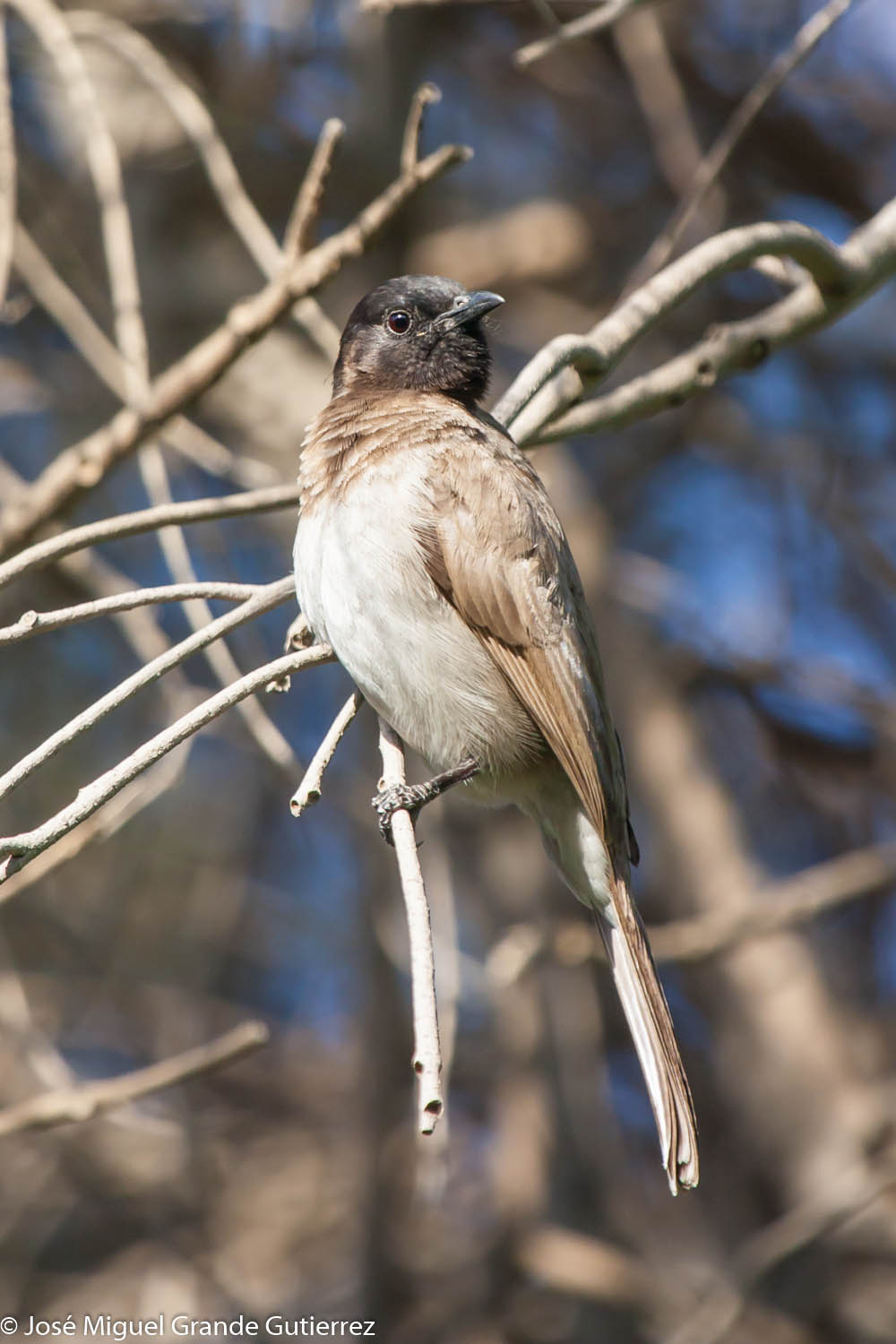
Bulbul naranjero (Barbatus)-Bulbul común-hombre Bulbul


naranjero Bulbul


(Common bulbul)

Widely distributed throughout much of Africa, where it is a very commonly bird, the naranjero bulbul plays within the Spanish territory, only in the Autonomous City of Ceuta, although so extremely scarce, as only a dozen known of couples.

Description

Classification

Order Passeriformes; family Pycnonotidae

Length

19 cm

Wingspan

Data not available

ID

It is a bird similar to the common blackbird, long thin beak and tail size, with earthy-brown coloration in the dorsal regions and quite dark head; underparts appear lighter, while the undertail flows present a tone between yellow and white, which is particularly striking (figure 1).

Singing

This is a rather garrulous species; continuously emits a claim similar to a babbling, consisting of an explosive and vacillating series of sounds -parecidos to those produced by the common blackbird when frightened. Sometimes utters shorter and melodious sounds.

naranjero Bulbul


(Common bulbul)

Widely distributed throughout much of Africa, where it is a very commonly bird, the naranjero bulbul plays within the Spanish territory, only in the Autonomous City of Ceuta, although so extremely scarce, as only a dozen known of couples.

Where do you live

In the world

It is widely distributed, with several subespecies- for much of the Ethiopian region where it reaches the southernmost parts of Africa.Within occupied Western Palearctic Morocco, Algeria, Tunisia, Egypt and northern Chad and the Autonomous City of Ceuta.

In Spain

Only in Spanish territory it is located in Ceuta. In Melilla, despite its proximity to Morocco, where it is a usual bird, it has not confirmed the presence of naranjero bulbul far. The subspecies living in Ceuta is barbatus, and it is recorded in the northwestern regions of the African continent.

displacements

It is shown sedentary in much of its range, although in North Africa can make short dispersive movements.

Poblaciónón

Although it is a common species throughout its range, the size of their populations is unknown. With regard to Spain, the small breeding population of Ceuta, which is considered stable in recent years is estimated at about 10 couples, although there is a lack of accurate data.

martes, 15 de marzo de 2016

Abejaruco esmeralda Cleopatra-Little Green Bee-eater [viridissimus or cleopatra] Merops orientalis [viridissimus, cleopatra or flavoviridis] (= Merops orientalis viridissimus) Swainson, 1837

Orden:
  Coraciiformes
Familia:
  Meropidae
Genus:
  Merops
Nombre científico:
  Merops orientalis viridissimus
Citation:
  Swainson, 1837
Reference:
  BirdsW.Afr. 2 p.82
Protónimo:
  Merops viridissimus
Geographic range:
  • Merops orientalis viridissimus: Savanna of Senegal to Eritrea, Ethiopia and w Sudan
  • Merops orientalis flavoviridis: Subdesert steppes of Chad to Red Sea coast of Sudan
  • Merops orientalis cleopatra: Nile Valley (Lake Nasser to delta)
Source: Clements checklist 2012
inglés:
  Little Green Bee-eater [viridissimus or cleopatra]
francés:
  Guêpier d'Orient [viridissimus ou cleopatra]
Situación Taxonómica:
Estatus de la especie: subspecies group (sometimes a species)
Este taxón es una subespecie de Merops orientalis 
información de:
http://avibase.bsc-eoc.org/species.jsp?avibaseid=0AAA530E40F8F610


lunes, 14 de marzo de 2016

Charrán elegante (Sterna elegans)-Elegant tern-Xatrac elegant

Descripción

Clasificación

Orden Charadriiformes; familia Sternidae

Longitud

39-43 cm

Envergadura

76-81 cm

Identificación

Es muy parecido al charrán bengalí y de tamaño similar, aunque tiene el obispillo y la cola blancos en lugar de grises. Posee un pico largo y muy delgado, algo curvo y de color anaranjado, a menudo con la punta más amarilla. Los adultos presentan la cresta larga y poblada. La especie puede confundirse también con híbridos de charrán bengalí y charrán patinegro.


Classification

Order Charadriiformes; family Sternidae

Length

39-43 cm

Wingspan

76-81 cm

ID

It is very similar to Bengali tern and of similar size, but has the rump and tail white instead of gray. It has a long beak and very thin, somewhat curved and orange, often with the yellow tip. Adults have long and populated crest. The species can also be confused with hybrids Bengali tern and sandwich tern.


sábado, 12 de marzo de 2016

Carbonero palustre (Poecile palustris)-Marsh tit-Mallerenga d’aigua-Kaskabeltz txikia-Ferreiriño palustre


marsh Tit

(Marsh tit)

FARROWED very similar to the much more abundant coal tit, which is distinguished by its completely black hood without the blot back of his neck, bib smaller and less gray and brownish shades general.It is relatively common in the forests of the northern third of the peninsula, which shows elusive and very restless while exploring endlessly trees, shrub borders and weeds.

Habitat

It operates primarily in mixed or dominated by ash trees, oaks, oak and beech forests. To a lesser extent, lives in melojares, quejigares, oak and riparian forests. It can also appear in orchards.preferably selected locations with presence of logs and stumps or rotting aged.

Feeding

It is an omnivorous bird, and perhaps calved concerned the higher proportion of plant material incorporated into your diet. In spring and summer it feeds on spiders and insects, while during the fall and winter consume seeds, fleshy and nuts. Creates temporary pantries at stumps on moss carpets or under leaf litter.

displacements

The marshy saithe is a sedentary bird. In general, couples are held together and faithful to breeding territory. Only in winter some shifts favoring observations in unusual habitats are detected.

Reproduction

It reproduces once a year, between the months of April and May, although most southern European populations can have two sunsets.Female, near the ground or inside cavities of trunks, builds a nest with moss, lined with hair and feather. Lays between 6 and 10 eggs, white and red paint, which incubate for 13 to 17 days, a period which is fed by the male. Subsequently, both 
sexes deal baiting the young. These, after 16-18 days (sometimes 21), leave the nest and stay a few weeks with their parents.Breeding pairs are very faithful to breeding territory over several years, even using the same hollowness to locate the nest. If a partner disappears, the other remains in the territory to mate again.

This section is adapted from the Encyclopedia of Birds of Spain , edited by SEO / BirdLife and the BBVA Foundation in 2008


El Carbonero Palustre pertenece al Orden de las Passeriformes, de la familia Paridae, su longitud oscila entre los 11 a 12 cm, su peso aproximado varia de los 10 a los 12 gramos, su longevidad llega alcanzar hasta los 3 años de vida.
Nos podemos encontrar con la dificultad de saber si realmente es el carbonero Palustre o el Sibilino, ante esta duda la mejor manera de diferenciarlos es su reclamo, no es un pájaro que le guste demasiado la cercanía con el hombre pero no le tiene miedo, así como sus parientes mas cercanos los carboneros comunes y los herrerillos frecuentan los jardines urbanos, el prefiere el bosque de robles o hayas.
Su cabeza es grande, muy brillante y el pileo negro hasta el cuello.
La primera observación la tuve en el bosque de Orgi, fue extraña por la fama de arisco y esquivo pero fue todo lo contrario hasta el punto que hubo momentos donde no podía ni enfocarlo de lo cercano que estaba.me miraba y en ningún momento sintió miedo a mi presencia.
Las alas son pequeñas, redondas y de un color gris pardo, las mejillas son claras y tiene un mentón también negro.
Al preferir árboles caduciformes su zona de distribución comprende desde Escandinavia, Gran Bretaña, Norte de Europa, Francia, Italia y el Norte de la Península Ibérica.
Es muy peculiar es el canto puede realizar variaciones desde sonidos fuertes como de enfado, a veces como los herrerillos comunes y hasta confundirse con un Carbonero Garrapinos.
Aprovecha mucho los huecos naturales de los árboles donde construye el nido con musgo, hierbas en forma de Taza.
Su dieta principal es insectívora, también se alimenta de semillas, bayas y en algunos casos de nueces, en parques o en zonas reservadas si se le pone comederos se acerca a alimentarse sin alterarle demasiado la presencia humana, no desprecia si se le presenta la ocasión comer arañas en el verano.