lunes, 21 de marzo de 2016

Escribano soteño (Cirlus Emberiza)-Cirl Bunting-Gratapalles-Hesi-berdantza-Escribenta común

Escribano soteño


(Emberiza cirlus)

Especie extendida y todavía relativamente común en nuestro territorio, el escribano soteño es un habitante de las lindes de bosque, de los sotos ribereños, de las praderas húmedas con arbolado disperso, de los setos vivos e, incluso, de parques y jardines. Aunque la intensificación agrícola y la utilización de insecticidas se han convertido en una grave amenaza para otras poblaciones europeas de este emberícido, en nuestro país no parece soportar problemas graves de conservación.

Dónde vive

En el mundo

El escribano soteño es una especie de distribución típicamente circunmediterránea, cuya población principal se concentra en Francia, Italia, las penínsulas Ibérica y Balcánica y Turquía. Algunas poblaciones aisladas llegan hasta el interior de Europa y el sur del mar Negro y alcanzan, por el oeste, el sur de las islas Británicas. Se reconocen varias subespecies.

En España

Se reparte principalmente por la zona mediterránea, Baleares y la mitad norte peninsular, aunque escasea en Asturias y Cantabria. En el resto del territorio aparecen núcleos reproductores fragmentados. Es un ave residente también en Ceuta, pero falta en Canarias y Melilla. La subespecie cirlus es la que está presente en España.

Desplazamientos

Este escribano es fundamentalmente residente, aunque las poblaciones más norteñas suelen realizar en los inviernos fríos desplazamientos cortos, normalmente inferiores a 100 kilómetros, para regresar al año siguiente hacia el mes de abril.

Poblaciónón

Se estiman en 1,2-4,3 millones de parejas reproductoras en Europa, de las cuales 500.000-800.000 se calcula que son españolas. Aunque los datos existentes sobre la tendencia demográfica de este escribano no son muy recientes, las poblaciones parecen ser estables o ir ligeramente en aumento, según se infiere de los datos recogidos en el programa SACRE para el periodo 1998-2005.

Esta sección es una adaptación de parte de la Enciclopedia de las Aves de España, editada por SEO/BirdLife y la Fundación BBVA en 2008


(Cirl Bunting)

still relatively widespread and common species in our territory, the Cirl Bunting is an inhabitant of the edge of forest, riparian thickets, wet meadows with scattered woodland, hedgerows and even parks and gardens. Although agricultural intensification and the use of insecticides have become a serious threat to other European populations of this emberícido in our country does not seem to support serious conservation problems.

Description

Classification

Order Passeriformes; family Emberizidae

Length

15 to 16.5 cm

Wingspan

22 to 25.5 cm

ID

Something less than the Yellowhammer size, colicorto Bunting is slightly more robust and has a peak. The general coloration also resembles the match, especially in young females (Figure 2).However, by the color of obispillo they differ - olive gray in soteño-, marked by the possession of sidebands in the face and, in general, have less yellowed areas in plumage. The male in breeding season (drawing 1) sports a wide stripe gray olive pectoral, a striking black bib in the throat and a mask of the same color; also it retains all the year and widely píleo nape of olive colored gray, with fine dark stripes.

Singing

The usual claim call is a thin, sharp and somewhat melancholy ittz;also emits a tiuu same characteristics, but more serious. Spring is singing in a rapid sequence of repeated notes, just over a second duration, sri-sri-sri-sri, which often changes tone to a sre-sre-sre.

Esta sección es una adaptación de parte de la Enciclopedia de las Aves de España, editada por SEO/BirdLife y la Fundación BBVA en 2008

miércoles, 16 de marzo de 2016

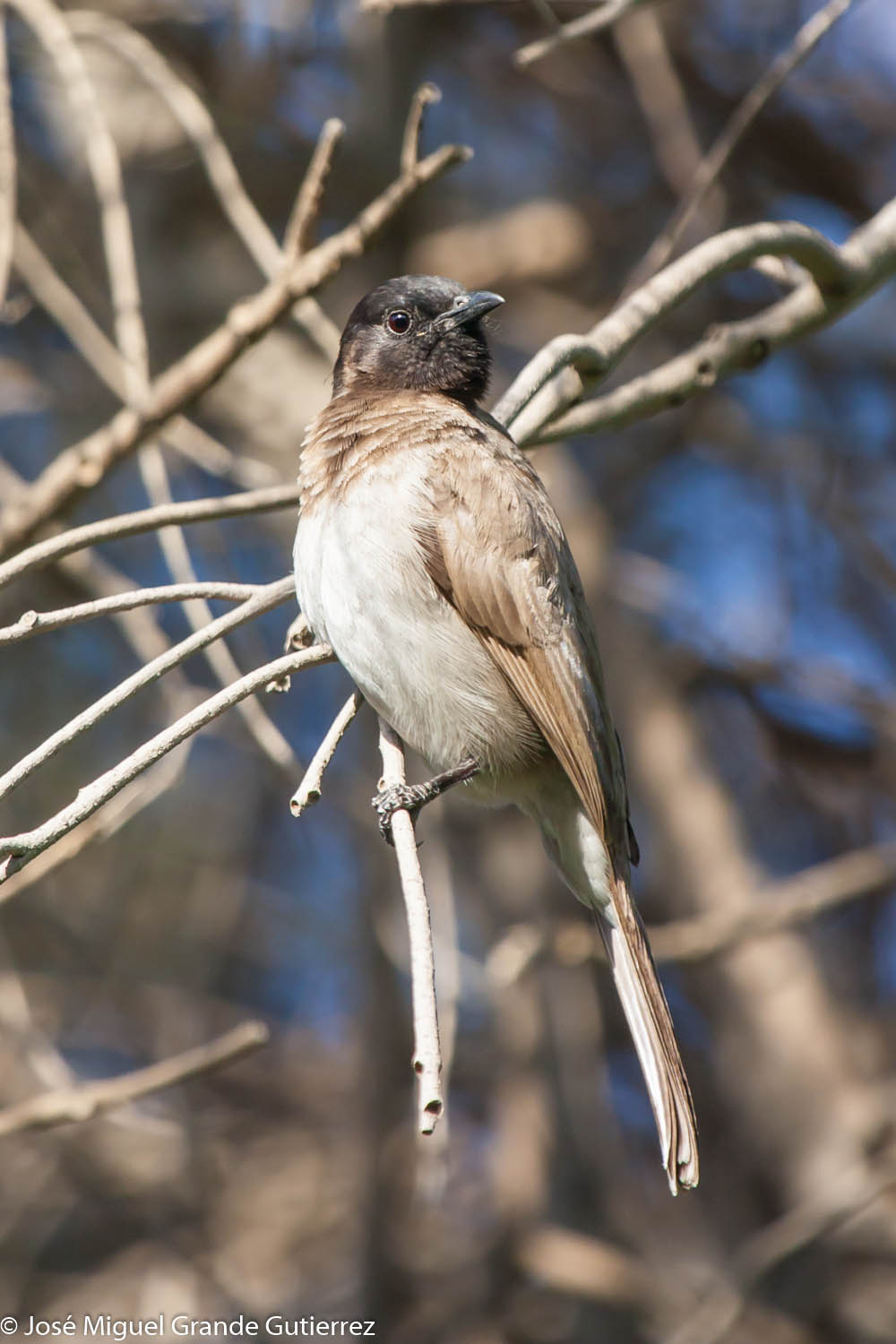
Bulbul naranjero (Barbatus)-Bulbul común-hombre Bulbul


naranjero Bulbul


(Common bulbul)

Widely distributed throughout much of Africa, where it is a very commonly bird, the naranjero bulbul plays within the Spanish territory, only in the Autonomous City of Ceuta, although so extremely scarce, as only a dozen known of couples.

Description

Classification

Order Passeriformes; family Pycnonotidae

Length

19 cm

Wingspan

Data not available

ID

It is a bird similar to the common blackbird, long thin beak and tail size, with earthy-brown coloration in the dorsal regions and quite dark head; underparts appear lighter, while the undertail flows present a tone between yellow and white, which is particularly striking (figure 1).

Singing

This is a rather garrulous species; continuously emits a claim similar to a babbling, consisting of an explosive and vacillating series of sounds -parecidos to those produced by the common blackbird when frightened. Sometimes utters shorter and melodious sounds.

naranjero Bulbul


(Common bulbul)

Widely distributed throughout much of Africa, where it is a very commonly bird, the naranjero bulbul plays within the Spanish territory, only in the Autonomous City of Ceuta, although so extremely scarce, as only a dozen known of couples.

Where do you live

In the world

It is widely distributed, with several subespecies- for much of the Ethiopian region where it reaches the southernmost parts of Africa.Within occupied Western Palearctic Morocco, Algeria, Tunisia, Egypt and northern Chad and the Autonomous City of Ceuta.

In Spain

Only in Spanish territory it is located in Ceuta. In Melilla, despite its proximity to Morocco, where it is a usual bird, it has not confirmed the presence of naranjero bulbul far. The subspecies living in Ceuta is barbatus, and it is recorded in the northwestern regions of the African continent.

displacements

It is shown sedentary in much of its range, although in North Africa can make short dispersive movements.

Poblaciónón

Although it is a common species throughout its range, the size of their populations is unknown. With regard to Spain, the small breeding population of Ceuta, which is considered stable in recent years is estimated at about 10 couples, although there is a lack of accurate data.

martes, 15 de marzo de 2016

Abejaruco esmeralda Cleopatra-Little Green Bee-eater [viridissimus or cleopatra] Merops orientalis [viridissimus, cleopatra or flavoviridis] (= Merops orientalis viridissimus) Swainson, 1837

Orden:
  Coraciiformes
Familia:
  Meropidae
Genus:
  Merops
Nombre científico:
  Merops orientalis viridissimus
Citation:
  Swainson, 1837
Reference:
  BirdsW.Afr. 2 p.82
Protónimo:
  Merops viridissimus
Geographic range:
  • Merops orientalis viridissimus: Savanna of Senegal to Eritrea, Ethiopia and w Sudan
  • Merops orientalis flavoviridis: Subdesert steppes of Chad to Red Sea coast of Sudan
  • Merops orientalis cleopatra: Nile Valley (Lake Nasser to delta)
Source: Clements checklist 2012
inglés:
  Little Green Bee-eater [viridissimus or cleopatra]
francés:
  Guêpier d'Orient [viridissimus ou cleopatra]
Situación Taxonómica:
Estatus de la especie: subspecies group (sometimes a species)
Este taxón es una subespecie de Merops orientalis 
información de:
http://avibase.bsc-eoc.org/species.jsp?avibaseid=0AAA530E40F8F610


lunes, 14 de marzo de 2016

Charrán elegante (Sterna elegans)-Elegant tern-Xatrac elegant

Descripción

Clasificación

Orden Charadriiformes; familia Sternidae

Longitud

39-43 cm

Envergadura

76-81 cm

Identificación

Es muy parecido al charrán bengalí y de tamaño similar, aunque tiene el obispillo y la cola blancos en lugar de grises. Posee un pico largo y muy delgado, algo curvo y de color anaranjado, a menudo con la punta más amarilla. Los adultos presentan la cresta larga y poblada. La especie puede confundirse también con híbridos de charrán bengalí y charrán patinegro.


Classification

Order Charadriiformes; family Sternidae

Length

39-43 cm

Wingspan

76-81 cm

ID

It is very similar to Bengali tern and of similar size, but has the rump and tail white instead of gray. It has a long beak and very thin, somewhat curved and orange, often with the yellow tip. Adults have long and populated crest. The species can also be confused with hybrids Bengali tern and sandwich tern.